Here is the pattern I saw over and over in the chair, and later heard from colorists I trained: a client comes in a year or two into an all-highlight routine, and her hair looks lighter than ever but somehow flat. Stripy at the regrowth. Bright but not rich. She asks for "more dimension," gets more highlights, and six months later the same complaint comes back louder.
The real difference between highlights and lowlights comes down to chemistry, and understanding that chemistry changes how you talk to your colorist about what your hair actually needs.
The surface-level answer, the one most articles give, is that highlights lighten and lowlights darken. True, but it does not explain why piling on more highlights made things worse, or why the fix isn't simply adding some dark pieces back in.
This is a color theory explainer, not a placement guide. If you already know you want highlights and are trying to decide between foils and balayage, that is a technique question this piece won't answer.
What Highlights Actually Do: Lifting Pigment Out
Highlighting is a lightening process. A lightener (often called bleach, though salon lightening powders and high-lift permanent color both work this way) uses an alkaline agent paired with a developer, a peroxide-based activator, to swell the hair's cuticle and diffuse into the cortex, where it oxidizes and breaks down melanin, the natural pigment that gives hair its color, per the color theory source cited in the developer breakdown just below. The pigment doesn't move anywhere. It gets chemically dismantled until it stops reflecting color, which is why lightened hair reads as pale gold, yellow, or eventually white rather than "clear."
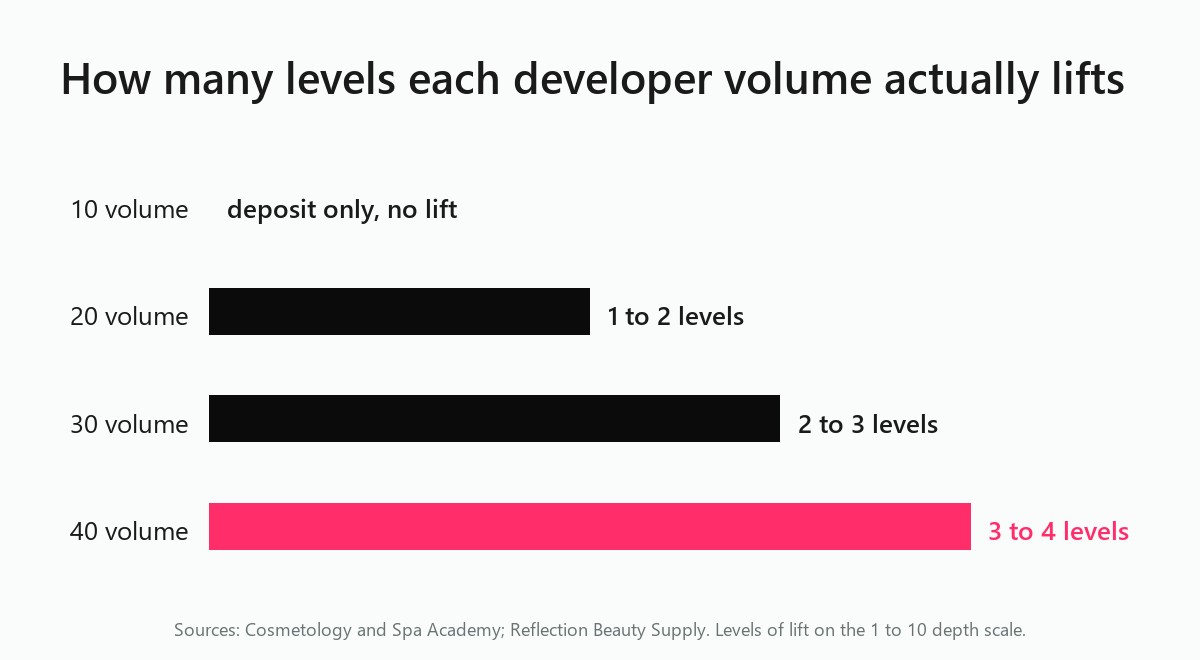
How much lift you get depends heavily on developer volume, the concentration of peroxide in the mix. A 10 volume developer deposits color with almost no lift at all, which is why it's the strength typically reserved for deposit-only work. Move up the scale and the lightening power increases in a fairly predictable band: 20 volume lifts roughly 1 to 2 levels, 30 volume lifts roughly 2 to 3 levels, and 40 volume, the strongest developer routinely used in a salon, lifts roughly 3 to 4 levels and is reserved for dramatic lightening work, according to Cosmetology & Spa Academy's color theory guide and corroborated by Reflection Beauty Supply's developer volume breakdown.
This is the mechanical reason an all-highlight head keeps drifting lighter even when a client swears she just wants a refresh. Every time lightener touches previously highlighted hair, even carefully, even just at the regrowth, it pushes those strands another notch up the level scale, the 1 to 10 system that measures how dark or light hair is. Repeat that at every regrowth appointment for a couple of years and the highlighted sections eventually cluster near the same pale level, which is exactly what erases contrast.
There's a separate, related problem that shows up on the same over-lightened hair: leftover warm pigment oxidizing unevenly and reading as brass. Our piece on why over-lightened highlights turn brassy walks through that mechanism in more depth, worth a look if that's your specific complaint.
What Lowlights Actually Do: Depositing Pigment Back In
Lowlights work in the opposite direction. Instead of lifting pigment out, they deposit color into the hair, and they typically do this with demi-permanent formula rather than full permanent color. The distinction matters more than most people realize, and it was the single most common formulation mix-up I saw new colorists make in training: reaching for permanent color out of habit when the job actually called for something gentler.
Permanent color uses ammonia, or an ammonia-equivalent alkalizing agent, to fully swell the cuticle open, letting pigment and peroxide penetrate deep into the cortex. It's usually mixed with a higher-peroxide developer, commonly 20 volume, and it can lift and deposit at the same time. Demi-permanent color skips the ammonia in favor of gentler alkalizers, like alkanolamines such as MEA or AMP, that swell the cuticle only slightly. It's mixed with a lower-peroxide developer, commonly 10 volume, deposits pigment closer to the outer cortex instead of driving it deep, and produces little to no lift on its own, per Beauty Hair's demi-permanent color guide.
That gentler mechanism is exactly why lowlights fade gradually instead of growing out with a hard demarcation line the way permanent color does. It also explains their timeline: demi-permanent color lasts roughly 4 to 6 weeks, commonly cited as about 24 to 28 shampoos, before it fades back toward the natural base, according to Colored Hair Care's research on demi-permanent color longevity. Highlights, by contrast, don't fade the same way because there's no pigment sitting near the surface to wash out. They grow out, which is a different problem with a different timeline entirely.
Depth, Tone, and the Hair Color Level System
To understand why a lowlight is never just "a shade darker," you need the two axes colorists actually think in: level and tone. Level measures depth only, on a 1 to 10 scale running from black at level 1 to the palest blonde at level 10. It says nothing about warmth or coolness. Tone is the separate axis, the warm-versus-cool, gold-versus-ash quality layered on top of that depth, the same level system explained by Hair.com's guide to hair color levels.
Here's what makes this practical: as hair lightens, it also reveals whatever contributing pigment sits at that level, the underlying color that was always there, masked by the darker pigment on top. Dark hair, at the lower levels, reveals red and orange contributing pigment as it lightens. Medium brown reveals orange and yellow. Light brown and blonde reveal yellow, per the same color theory source cited above.
The exact boundary between one zone and the next varies a bit between color theory sources, so treat this as a general map rather than a precise chart. What matters is the underlying principle: whatever warm cast shows through lightened hair comes from pigment that was there all along, waiting to be uncovered.
Tone families work in complementary pairs, the same relationships you'd find on a basic color wheel. Orange and blue sit opposite each other, which is one reason a blue-based, ash-toned formula is often the choice used to calm down orange contributing pigment. Red and green work the same way, which is why a green-based corrector shows up in formulas built to fight red or pink cast, per the color theory source cited above. A colorist picking a lowlight tone is choosing the color positioned to cancel out whatever warmth that specific level is about to expose, not guessing from a swatch ring.
Put level and tone together and you get the actual definition of dimension: the contrast range between your lightest sections and your darkest sections. Overall lightness by itself has nothing to do with it. Two heads can sit at the exact same average level and look completely different, one flat and one dimensional, purely because of how wide a level spread exists between the highlighted and lowlighted pieces. This is also why an all-highlight head goes flat over time even as it stays "blonde": every section drifts toward the same narrow band on that 1 to 10 scale, and a narrow band reads as flat no matter how light it gets.
How a Colorist Actually Chooses a Lowlight Color
Because level and tone move independently, picking a lowlight formula by eye, just grabbing "a shade darker" off a swatch ring, skips the two questions that actually determine the outcome. First, what level is the hair sitting at right now, as opposed to where it was when it was virgin, meaning never colored? Second, what contributing pigment is going to surface as that lowlight formula processes, and does the formula account for it? A colorist working through a well-trained process is essentially solving for both at once, choosing a target level that will sit far enough from the existing highlights to read as contrast, and a tone that will neutralize or complement whatever warmth the base level is going to throw.
I remember correcting this exact mistake more than once in the training room: a colorist would formulate a lowlight based purely on how many levels darker it looked in the bowl, then watch it pull orange the moment it processed, because the client's base level was already primed to throw warm contributing pigment the formula never accounted for. Adjusting the tone to work with that warmth, rather than ignoring it, fixed the color every time.
Skip that second step and the lowlight lands somewhere other than the color you mixed in the bowl, because the underlying pigment fights the intended tone instead of getting accounted for. This is the same underlying-pigment logic from the level system section above, just applied in the other direction. Instead of asking what warmth lightening will expose, you're asking what warmth a deposit-only formula needs to work around or replace.
Why Lowlights Fade Fast or Turn Muddy on Lightened Hair
This is where a lot of the "too light but somehow dull" complaint actually originates, and it's worth separating from the highlight side entirely. Deposit-only color depends on a reasonably intact cuticle to hold pigment near the hair's surface. Hair that has already been lightened has a more porous cuticle, porosity meaning how open or raised the cuticle layer is, because prior bleach or high-lift color has already worked it open. Porous hair grabs pigment unevenly and releases it faster with every wash, which is the direct mechanical reason lowlights on previously lightened hair fade noticeably faster than the same formula would on virgin hair, per Beauty Hair's demi-permanent color guide cited above.
The muddy or ashy-gone-wrong result is a separate but related failure. Pre-lightened hair has already had its natural warm pigment stripped out. If a lowlight formula is built to replace that warmth, the way rich, dimensional lowlight formulas typically are, and there isn't enough natural warmth left to work with, the result reads as flat and drab instead of rich. Our article on how LA water and sun accelerate fade covers a related fade mechanism, worth a read if you're chasing down every reason your color isn't holding.
None of this means lowlights are a bad idea on lightened hair. It simply means the formula and the timeline need to account for porosity instead of assuming virgin-hair behavior.
A Diagnostic Script for "Too Light But Still Dull"
If your hair currently reads as light but flat, resist the reflex to book another highlight appointment. Bring your colorist enough information to diagnose the actual cause instead, whether that's too little contrast, a porosity problem, or both. Here are questions worth asking before you book that appointment:
- What level am I actually at right now, compared to where my highlighted sections and my natural regrowth sit? This tells you how much contrast range currently exists.
- Is my hair porous enough that a lowlight needs a filler step first? A filler is a pigment step some colorists use to replace lost warmth in porous hair before the main color goes on, so the final tone has something to hold onto.
- Are we adding warmth back into these lowlights, or trying to go ashier? This forces a tone decision instead of leaving it implied.
- Given how my hair has faded in the past, should this be permanent or demi-permanent color, and why?
A colorist who can answer these specifically, naming a level, naming a tone, naming a reason for the formula choice, is working from the color theory in this article rather than guessing from a swatch book. That's a reasonable thing to expect and a fair way to evaluate the technical skill behind any color service, not only a lowlight (our piece on questions worth asking before you book a colorist covers more ground here).