
Clients ask me this before I've even mixed the bowl: how long does a hair gloss last? The honest answer depends on which gloss you're getting, but here's the number that surprises most people. Redken's own product page states that Shades EQ Gloss, the professional acidic demi-permanent gloss used in most LA salons, "last[s] up to 28 shampoos." Wash two or three times a week, and that stretches to roughly nine to fourteen weeks, well past the generic "four to six weeks" answer you'll find on most gloss articles.
That range only holds for one specific type of gloss, though. A drugstore toning gloss fades differently than a quick clear glaze, and your hair's own condition changes the math more than most people expect. Almost nobody breaks this out by type, so let's fix that.
Fade Timelines by Gloss Type
"Gloss" gets used loosely across the industry, and half the confusion clients bring into my chair starts right there. If you want the chemistry that separates a gloss from a toner, our gloss versus toner breakdown covers that in depth. For this piece, what matters is how long each type actually holds.
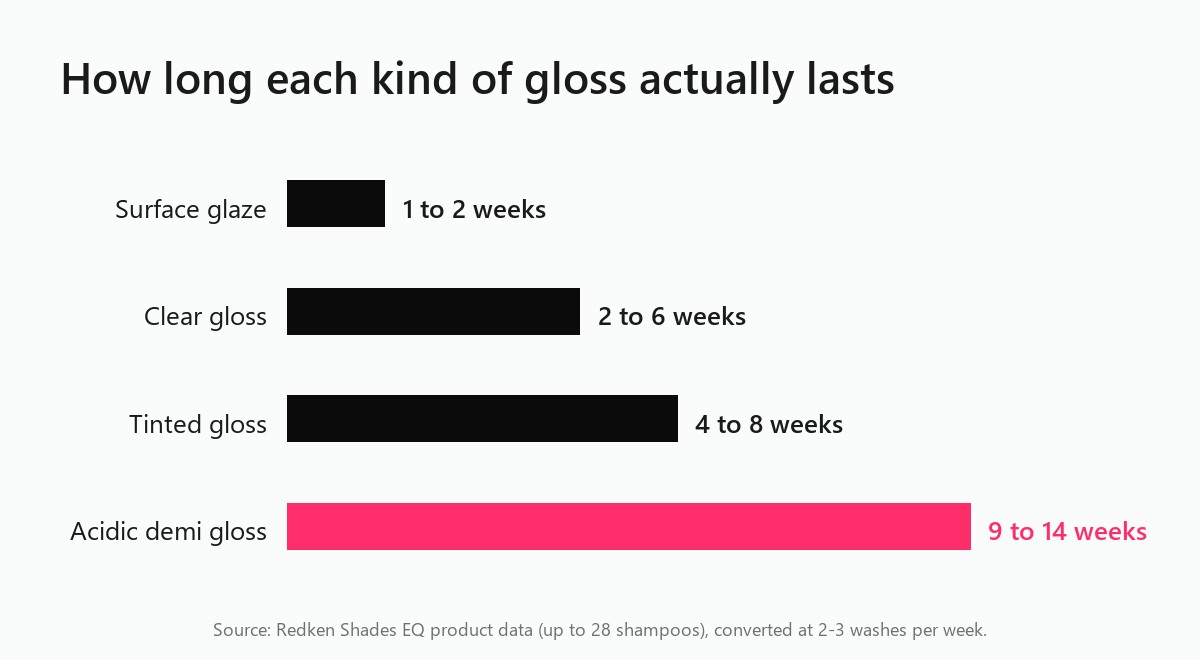
Clear or shine-only gloss carries no pigment. It smooths the cuticle and boosts reflection, and that effect calms down within roughly two to six weeks. There's no color molecule anchoring anything, so once the shine settles, the treatment has run its course.
Tinted or toning gloss, the kind you'd buy at a drugstore for an at-home refresh, typically holds four to eight weeks. Pigment molecules take longer to rinse out than plain shine does, which buys a client a bit more runway between salon visits.
Professional acidic demi-permanent gloss is the one with real data behind it. At the confirmed 28-shampoo mark from Redken and an average wash frequency of two to three times a week, that works out to roughly nine to fourteen weeks in the real world. This is the gloss most colorists in Silver Lake and WeHo reach for when a client wants depth and shine without permanent commitment.
Quick surface glazes sit on top of the cuticle instead of penetrating it. Colorists commonly see these fade within one to two weeks, since there's no pigment actually settling into the hair shaft. If a client wants something for one event and doesn't care what happens after, this is the category, but don't expect it to survive a second wash cycle looking the way it did on day one.
Most articles you'll find give you one blanket number, usually somewhere around four to six weeks, and call it done. That number isn't wrong for a middle-of-the-road tinted gloss on average hair. It's just useless for anyone outside that middle, and that was most of my clients.
A client with a professional acidic demi gloss and healthy, low-porosity hair was leaving money on the table by rebooking too early, sometimes weeks before she needed to. Someone with a quick glaze on freshly bleached ends walked out disappointed when her "gloss" faded before she even made it to a second wash. Neither client was wrong to expect more clarity going in.
How Porosity Changes the Math
Here's the counterintuitive part I used to explain at the shampoo bowl. High-porosity hair, meaning hair that's been previously lightened, chemically treated, or damaged by heat, grabs color fast during application. It looks vivid the second I rinse it. But that same raised, roughened cuticle that let pigment in so easily also lets it leak back out with every wash.
In my chair, that meant a fresh balayage client with lifted ends would often see her gloss fade within two to three weeks, even on the exact same product that held far longer on a client with healthy, low-porosity hair. Fast in, fast out. Porous hair takes color up quickly and gives it back just as quickly; it doesn't actually hold more of it.
Healthy, low-porosity hair holds a gloss closer to the full range listed above, because the tighter cuticle traps pigment instead of leaking it. If you've never colored your hair before, or it's been a while since your last lightening service, you're the client who gets the longest mileage out of any gloss type.
Timing After a Lift vs. Color-Safe Hair
Freshly bleached hair sits at its most porous right after lifting. A gloss applied that same day tends to fade sooner than one applied a few weeks later, once the hair has had time to recondition and the cuticle has relaxed somewhat.
That doesn't mean you should skip toning right after a lift. Colorists still apply gloss immediately post-lightening to neutralize brassy or yellow undertones before they set, which is a separate job from longevity. Think of that first gloss as damage control for tone, not a longevity play.
The scheduling takeaway applies to your next stand-alone gloss appointment, the one that isn't riding along with a lightening service. Hair that's been color-safe for several weeks, with no fresh chemical service in that window, holds a stand-alone gloss noticeably longer than hair still recovering from a recent lift. If you just got highlights and you're already thinking about a refresh gloss, wait until your hair has had time to recondition before you book it.
What Actually Cuts a Gloss Short
A handful of everyday habits shave real time off a gloss, and once you know what they are, most of them are easy to manage around.
Wash frequency
Washing daily is the single fastest way to burn through a gloss. In my experience, daily washers see their gloss fade within about two to three weeks no matter which type they got, while clients who wash two or three times a week get much closer to the full range. Every wash is a small chance for pigment to rinse out, so fewer washes means more gloss left at the end.
Hot water
Hot water opens the cuticle further than warm or cool water does, which gives pigment an easier exit route with every rinse. Lukewarm water for the wash and a cool final rinse is a small habit that adds up over weeks, not days.
LA's hard water
This one is genuinely local. Los Angeles tap water measures 254 parts per million, or 14.9 grains per gallon, which puts it in the "very hard" category, according to a water-hardness lookup site citing LADWP figures. Calcium and magnesium minerals in that water deposit on the hair shaft with every wash, building a film that dulls color and can push tone brassier, according to Kenra Professional's guidance on hard water. Our breakdown of how LA's hard water and summer sun compound to fade color goes deeper into that mineral load if you want the full picture.
Kenra's own guidance stops short of a week-by-week comparison, but the direction is clear: hard water shortens a gloss's hold, and soft or filtered water extends it. A shower filter is one of the cheapest things a color client in this city can buy, and it's the one product I recommended more than any other during my years behind the chair. It won't undo hard water's effect entirely, but it slows the mineral buildup down.
Chlorine
Chlorine reacts with water to form hypochlorous acid, which opens the hair cuticle and then breaks down pigment molecules inside it, affecting both artificial color and natural melanin. That's well-established across professional hair-care sources as general knowledge, and it's exactly why a summer of pool days fades a gloss faster than a client expects. Wetting your hair with clean water before you get in the pool reduces how much chlorinated water the hair shaft actually absorbs, since already-saturated hair has less room to soak up pool water. Our guide to protecting color-treated hair through LA summer covers the full pool-and-sun routine season to season.
Sun and UV exposure
Direct, unprotected sun exposure is commonly cited as capable of visibly dulling a gloss within three to four weeks instead of the fuller range for its type. UV light degrades pigment through oxidation, the same general process that fades a car's paint job or a poster left in a window. In a city with near year-round sun and an outdoor lifestyle built around beach days and rooftop pools, this is one of the biggest gloss killers I saw in the chair, right up there with hard water.
Clarifying shampoo
Living Proof's own guidance states that clarifying shampoo "can cause color to fade faster" and recommends using it no more than once a week on color-treated hair. Clarifying shampoos use higher concentrations of surfactants, often sulfates, that lift oil and product buildup and take color pigment with them. Semi-permanent color, which is closer to how a gloss behaves than permanent dye, is specifically called out as more vulnerable to clarifying shampoo. If you swim regularly or use a lot of styling product, you'll want that clarifying wash, but save it for the day before your next gloss appointment, not the week after. For more on which everyday shampoo ingredients strip gloss fastest, see our breakdown of shampoo ingredients that wreck colored hair.
Dry shampoo buildup
Dry shampoo's effect on gloss is indirect rather than chemical. Some colorists note that heavy dry-shampoo users end up needing to wash more often just to clear the residue, and that extra washing is what shortens gloss life, not the product reacting with the color itself. If you're reaching for dry shampoo most days and washing more because of it, that's the real culprit, not the product itself.
Planning Your Gloss Around Your Color Calendar
Once you know your gloss type and your hair's porosity, scheduling gets simple. Give your hair a few weeks to settle first after any lightening or full-color service before you book a stand-alone gloss. Booking sooner just means you're glossing hair that's still at its most porous, which wastes some of the gloss's potential life.
From there, plan around the type you're getting. A professional acidic demi gloss holding nine to fourteen weeks means most clients can pair it with their regular root touch-up or highlight refresh cycle, since those tend to land in a similar window. A tinted drugstore gloss on the shorter four-to-eight-week range needs its own separate booking if you want continuous coverage between salon visits.
Ask your colorist two questions before you book: which type of gloss are they using, and how does that fit your existing color calendar? A colorist who can't answer the first question, or who treats every gloss the same regardless of what's already on your hair, is a colorist who isn't thinking about your maintenance schedule. That's a fair thing to ask about before you sit down.
I used to map this out on paper with clients who colored regularly. Say you get highlights every ten to twelve weeks. A stand-alone gloss around week five or six, right in the middle of that window, keeps tone fresh without competing with the lightening service on either end.
Clients who tried to squeeze a gloss in during week one or week nine usually ended up disappointed, either because the hair was still too porous to hold it, or because a new lightening service was about to wash it out anyway. The middle of your color cycle is almost always the right spot for a stand-alone gloss, and it's worth saying out loud to your colorist when you book.