
Ask five colorists "how long does balayage last" and you'll get five different answers. That's not because any of them is wrong. They are answering different questions.
Some mean when the root needs new placement. Others mean when the toner turns brassy. A few mean when the hair itself needs a trim or a bond treatment before it starts snapping. All three answers can be correct at the same time, because all three run on separate schedules.
That mismatch is exactly what brings clients back to the chair right around the time a toner gives out, four to six weeks in, frustrated because their roots still look fine but their blonde has gone muddy or yellow. The placement is not the problem yet. The toner sitting on top of it already gave out.
Balayage runs on three clocks: placement, tone, and structure. Here is how each one actually works, and what Los Angeles conditions do to speed all three of them up.
The Placement Clock: How Long Before You Need a New Balayage
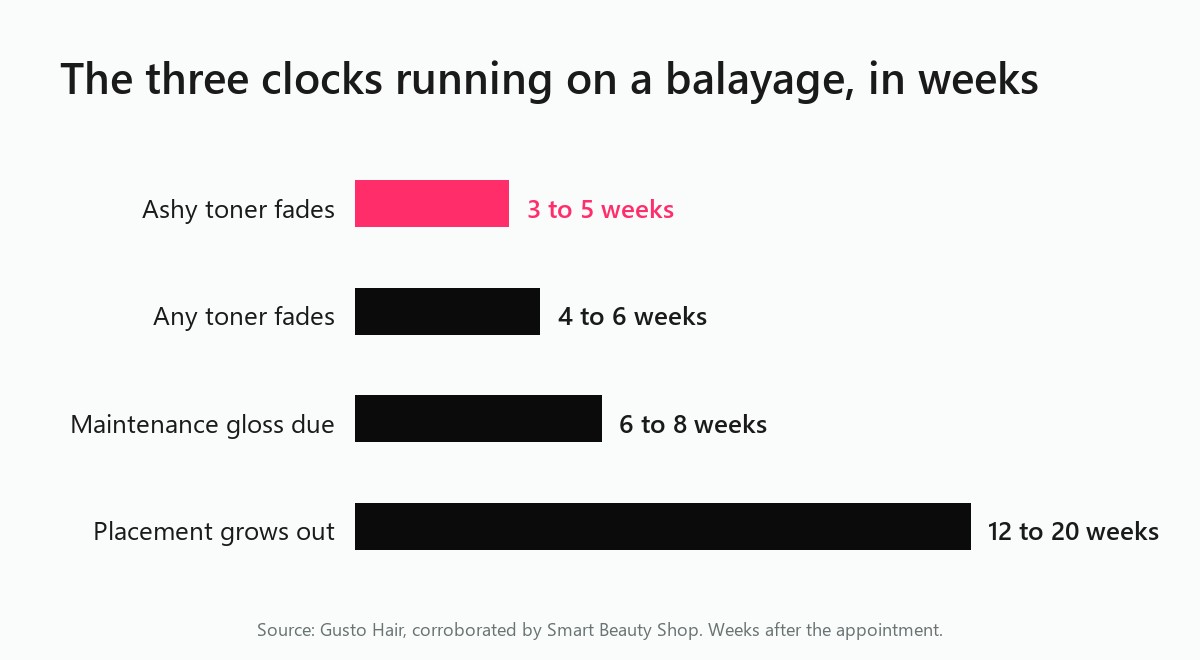
A full balayage refresh, meaning new hand-painted placement rather than a simple toner touch-up, most commonly falls in the 12 to 16 week range. Some clients stretch to 20 weeks when the contrast between their natural base and their lightened pieces is low and their aftercare is solid. Gusto Hair, a colorist-authored salon blog, puts that range at 12 to 16 weeks in its week-six brassiness post, and the number holds up across other colorist blogs too. It's professional consensus rather than a controlled study, but it's not just one stylist's opinion.
Balayage was built to stretch out that placement clock in the first place. It's not painted from the root the way foil highlights are, so there's no hard line as new growth comes in. The natural base blends into the lightened lengths instead of creating a visible demarcation. L'Oréal Professionnel's own colorist-education page confirms this graceful grow-out mechanism, though that page does not publish a specific week range for it.
Your starting point still matters. The more a colorist has to lift your natural color to reach the target shade, the more contrast sits between your root and your lengths. That contrast starts reading as grow-out instead of dimension sooner. A dark brunette going to light blonde will typically need a placement refresh sooner, visually, than a dark blonde going lighter, even if both heads are chemically due around a similar week.
I saw this split constantly in the chair: two clients booked around the same time, one already showing a visible line while the other still looked blended and glowing weeks later, purely because of how much lift each color needed.
Texture plays a supporting role too. Fine or already-processed hair tends to be more porous, which affects how fast the tone on top fades rather than how fast the placement itself grows out. Think of both effects as general tendencies rather than an exact week count: more lift and more porosity both close the visual window sooner.
A full balayage appointment is also a slower process than a root touch-up, because the colorist is hand-painting each section rather than running color through foil packets mechanically. Expect a lot of sectioning, checking the light against your face and part, and re-painting pieces that need softer edges. If you want the lowest-maintenance version of this clock, ask your colorist about what low-maintenance color actually means for your specific base and target shade before you book.
The Tone Clock: Why Your Toner Fades Weeks Before the Lift Does
This is the distinction that resolves most of the confusion. The lift underneath your balayage is a structural, permanent change to the hair. The toner or gloss sitting on top of it is a temporary color deposit, and it oxidizes and washes out far faster than the lift grows out. Your placement can still have three months of life left while your tone has already turned.
Demi-permanent toner and semi-permanent gloss typically fade over 4 to 6 weeks. Cool, ashy toners fade faster still, often within 3 to 5 weeks, especially with frequent washing. Colorists commonly recommend booking a maintenance gloss around the 6 to 8 week mark, before full brassiness sets in rather than after. This week-by-week fade pattern comes from Gusto Hair's colorist-authored piece on toner behavior.
One practitioner trick worth asking about: choosing a toner formulated half a level to a full level darker than your actual target shade. Toner fades toward the underlying lift rather than staying put, so a slightly darker starting toner drifts toward the goal shade instead of away from it. That reportedly adds three to four weeks of wear, per the same source above. Treat this as a helpful tip your colorist may offer, not a guaranteed outcome for every head of hair.
Curious about the chemistry? The real difference between a gloss and a toner, including which one your colorist should actually be reaching for, gets its own full explanation elsewhere on this site.
The Structural Clock: When Your Hair Needs More Than a Touch-Up
The third clock is not measured in weeks. It is measured in how your hair actually feels and behaves after repeated lightening, and it does not run on a fixed calendar the way placement and tone do.
Bleach lifts pigment by penetrating the hair shaft, and in that process it breaks disulfide bonds, the internal protein cross-links responsible for hair's strength and elasticity. Once those bonds break, the cuticle lifts, and hair becomes rougher, more porous, and worse at holding onto moisture. This is standard, well-documented cosmetology chemistry, laid out on L'Oréal Paris's own hair-care education page.
Bond-repair treatments, whether an in-salon add-on or an at-home product, work by rebuilding those internal bonds using ingredients like citric acid, peptides, amino acids, and ceramides, per the same L'Oréal Paris source. Good colorists protect this clock by refusing to re-lighten hair that is already processed. Fresh lightener goes on new growth only, and colorists typically avoid re-lightening the same lengths sooner than about two months out, since compounding bleach on already-processed hair is how breakage happens.
Watch for the actual signals instead of counting weeks: hair that feels rough or overly porous, or that stretches when wet and doesn't spring back. That's your cue for a bond treatment or a cut, not another color appointment.
If your colorist skips this conversation entirely at your consultation, that is worth asking about directly before you sit down for a full lightening service. Whether a bond-building add-on is worth it, and when it actually earns its price versus when it's just an upcharge, is a question worth reading up on before you decide.
LA Accelerants That Shrink All Three Clocks
Every clock above assumes average conditions. Los Angeles does not offer average conditions for most of the year.
Sun exposure ages color and hair faster than most people expect. Dermatologist Wilma Bergfeld of Cleveland Clinic puts it plainly: "the sun strips color, too," and notes that dyed or bleached hair is especially vulnerable to it. She describes UV damage as the outer cuticle breaking down, which leaves hair "drier, frizzier or brittle" and straw-like over time. That guidance comes from Cleveland Clinic's page on protecting hair from sun damage.
In a city with this much sun on the calendar, that cuticle stress adds up fast on already-lightened hair.
LA's tap water compounds the problem, and this site's hard-water and summer-UV article walks through the full mechanism in more detail. The short version here: LA runs hard, and layering that mineral load onto peak summer sun moves your tone clock faster than most colorists quote off the top of their head.
Then there's chlorine, a chemical threat all its own. Dr. Joe Cincotta, chief chemist at Color Wow, describes chlorine as "a powerful oxidant" that "will easily enter the hair and begin breaking down your melanin and any artificial color." He adds that it also breaks down protein bonds and destroys the lipids that keep hair hydrated, per Color Wow's breakdown on chlorine. The green tinge some blondes pick up in the pool is not chlorine itself; it is oxidized metal, usually copper, binding to porous, color-treated hair.
Ocean water plays by different rules than sun or chlorine. It is not much of an oxidizer, so it is not attacking pigment directly the way chlorine or UV does. Its main mechanism is dehydration: it draws moisture out of the hair shaft and lifts the cuticle, raising porosity. That speeds up how fast your toner fades rather than bleaching color the way an oxidizer would.
Dry shampoo adds a quieter drag on all of this. Heavy buildup at the root dulls shine and can make freshly toned hair look flatter and duller sooner than it actually is. Worth remembering before you assume your color has faded when your scalp routine is the real culprit.
The Maintenance Gloss: What It Actually Does and What It Costs
Expect roughly $30 to $80 for a standalone gloss or toner refresh between full balayage appointments in most markets, more in higher-end LA studios. These are aggregated, typical ranges pulled from salon-industry sources, not a single verified price list. Added on during a full color service, it commonly costs an extra $25 to $60. Frequency depends on how demanding your shade is: most commonly every 6 to 8 weeks, high-maintenance blondes sometimes need one closer to every 4 to 5 weeks, and lower-maintenance brunette balayage can often stretch to 8 or even 12 weeks between glosses.
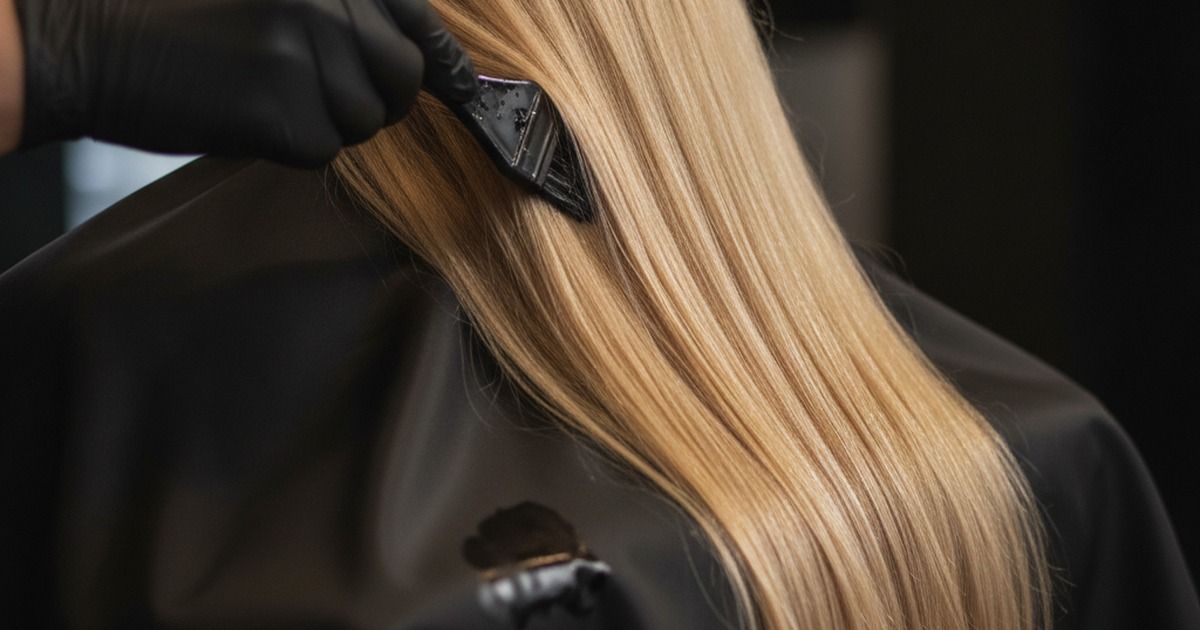
Here is what actually happens in the chair. Your colorist shampoos your hair and sections it the way they would for any color service. Then they brush on a gloss or toner formula, often a low-volume developer or a direct-dye acidic formula, onto hair that is already lightened.
It processes for a shorter stretch than a full balayage appointment because there is no lightener involved and no lift happening. You won't smell the sharp ammonia note that comes with bleach. It is a quieter, faster appointment than the one where you got your balayage in the first place.
What a gloss does not do matters just as much as what it does. It deposits pigment and shine onto hair that is already lightened. It doesn't lift hair any further, and it doesn't reset your placement or structural clock. Only the tone clock moves.
A $40 gloss buys you several more weeks of good color. It doesn't buy you out of the eventual full appointment once your regrowth catches up.
Choosing Balayage in the First Place
If you're still deciding whether balayage is the right technique for you, rather than just maintaining one you already have, the calculation changes. Foil highlights create a more even, saturated result but grow out with a visible line much sooner than balayage does. Want the full side-by-side? A separate article on this site compares balayage to foiled highlights, including which base levels and textures tend to suit each technique best.
Having that conversation with your colorist before you book saves you from chasing the wrong maintenance schedule six months down the line.