
Pull up two LA salon menus side by side and search for the word "balayage." Same technique, same-sounding description, wildly different numbers underneath. That gap is the whole story behind balayage cost in Los Angeles: the final number is a stack of separate decisions, and most menus only show you the bottom of the stack.
Here is the scenario, and if you have priced out an appointment recently, it will sound familiar. A salon quotes balayage around $250. You book it because the number sounds reasonable, and by the time you are standing at checkout, the receipt reads closer to $340.
Nothing went wrong there. The toner got added, the blowout got added, and both landed on top of a base price set for hair as long as yours. The salon simply quoted the floor of a range that always had a ceiling.
What's Actually Inside a Balayage Price
Balayage is a freehand painting technique, which is part of why its pricing behaves so differently from a full head of foils. A colorist is hand-sweeping lightener onto sections of hair rather than isolating strands inside foil packets, and that hand-work is priced by time, by product volume, and by the density of what they are painting. Full balayage at The Look Hair Salon, a Glendale-area LA salon, runs roughly $200 to $350 or more, with a partial version (fewer sections, usually around the face and crown) priced at $150 to $250.
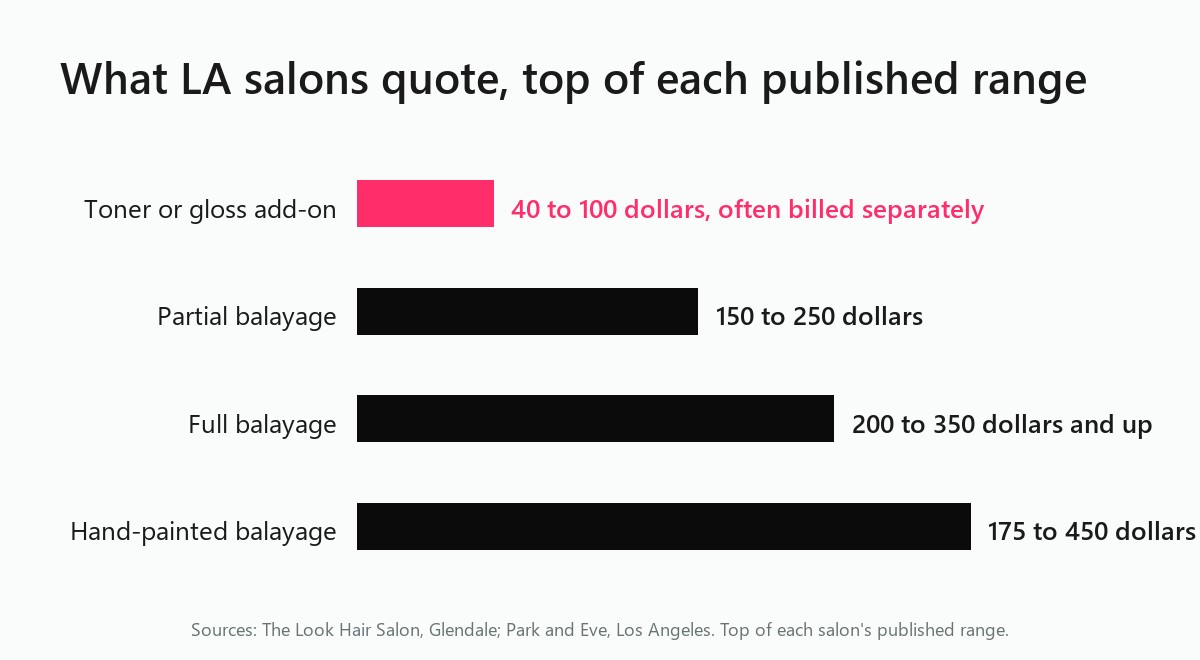
Park & Eve, a Los Angeles studio, prices its hand-painted balayage service at $175 to $450 or higher, depending on the same variables.
Put those two real, LA-published price lists next to each other and you get a realistic market range of roughly $150 to $450 or more for the base service alone, before anything gets added on top. That's a $300 spread on the word "balayage" by itself, and neither salon is padding the number. They're pricing different amounts of time and product against the same technique name.
Colorist Level and Demand
Ask any front desk in LA how two colorists at the same salon can charge different amounts for the identical service, and the honest answer is that you are often paying for a waitlist as much as a skill level. A junior or associate stylist and a senior or master colorist can both execute a technically sound balayage, but the senior colorist has years of client relationships, a following built partly on Instagram and TikTok, and a book that fills up weeks out. Fash, a cost aggregator that tracks salon pricing nationally, found junior stylists charging noticeably less than senior colorists for comparable balayage work, a gap Fash attributes to experience and client demand, not a difference in the underlying technique.
That pattern shows up nationally, and LA's colorist culture amplifies it. When a stylist builds a public following, demand pricing follows. The practical upshot: the fastest way to know what tier you are booking into is to ask directly where a colorist sits on the salon's pricing structure before you commit, which is one of several reasons it pays to work through the questions that surface hidden add-ons before you sit down rather than booking off a menu price alone.
Hair Length and Density
Length and density move the number almost as much as the colorist's tier does, and this is the variable most people underestimate when they compare a friend's receipt to their own quote. A pixie cut, mid-length hair, and hip-length hair are not the same service even if all three get called "balayage." More hair means more lightener, more painting time, and often a longer appointment window. Clients with hair extensions ask about balayage too, though pricing there is its own conversation with the colorist rather than a menu line item.
The time structure backs this up. Per The Look Hair Salon's own pricing page, partial balayage typically takes about 2 to 3 hours, a full balayage runs 3 to 4 hours, and long or thick hair can push a session to 4 or 5 hours, with a length surcharge layered on top of the base price range. That $150 spread is the width of the same salon's own full balayage band, $200 to $350, before a single add-on enters the conversation, and how much hair the colorist is working with is a large part of what moves you across it.
Toner or Gloss: Bundled or Billed Separately
This is the single line item that explains most of the gap between what a menu promises and what a receipt delivers. Toner and gloss are finishing steps that neutralize brassiness and set the final tone after lightening, and whether that step is baked into the quoted balayage price or billed on top depends entirely on the salon's own menu structure. Nobody standardizes this across LA, which means the same phrase can mean two different totals depending on which door you walk through.
At The Look Hair Salon, toner or gloss is priced as a $40 to $75 add-on with roughly 30 extra minutes when it is not already folded into the balayage price. At Park & Eve, gloss or toner is priced separately starting at $100 or more.
Those two figures simply don't overlap, which is exactly why a quote that skips whether toner is included leaves out the most important part of the total. It's worth understanding what a toner or gloss line item actually buys you before deciding whether a lower headline price is really the better deal.
Foils and Foilyage Add-Ons
Some clients come in asking for balayage and leave the consultation booked for something closer to foilyage instead, a hybrid technique that layers foils over hand-painted sections for more dimension and a more saturated result. Foilyage takes on more of the volume and precision of a full foil service while keeping balayage's soft, hand-painted placement, and that added technical work is why, per Fash, it typically runs as a step up in price from freehand balayage.
If a colorist suggests moving from a straightforward balayage into foilyage during your consultation, that's a legitimate technical upsell you can accept or decline. Either way, it's worth having them name the new total before the foils go in.
Blow-Dry and Finish
Your salon isn't being unusual if this one feels unclear. Behind The Chair, a stylist trade publication, has covered stylists arguing both sides of whether a blowout belongs in the color price or gets billed separately.
Practically, that means the finish, the styled, blown-out result you walk out with, can either be included in your balayage total or tacked on afterward depending on the salon's own policy. It's a detail worth confirming rather than assuming. Ask.
The Neighborhood Factor
Where the chair sits matters, even if nobody publishes a clean formula for how much. Commercial rent, staffing costs, and the density of high-spending clientele all vary block to block across Los Angeles, and salons price accordingly. A studio paying premium retail rent in a high-demand submarket carries different fixed costs than one in a lower-rent stretch of the city, and that overhead has to show up somewhere in the service menu. That is part of why LA's neighborhoods differ so much in color culture and pricing in the first place.
This is a directional principle rather than a formula, since none of the LA salon pricing pages reviewed for this article published a neighborhood-by-neighborhood comparison. Treat "location affects price" as a real, common-sense factor rather than a fixed premium. What you can do instead: ask the salon directly whether its posted price range reflects a citywide average or that specific location's own overhead. A front desk that has actually thought about this will have an answer.
California's Hidden-Fees Law and What an Honest Quote Includes
There is a legal backdrop to all of this that most balayage cost guides skip entirely. California's SB 478, often called the Honest Pricing Law, took effect on July 1, 2024, and it makes it unlawful for a business serving California consumers to advertise, display, or quote a price that leaves out mandatory fees. The California Attorney General's office puts it plainly: "the price a Californian sees should be the price they pay." The only carve-outs are government taxes, reasonable shipping charges, and add-ons the customer genuinely chooses to opt into.
Apply that logic to a salon chair. If toner, gloss, or a blowout is treated as a mandatory finishing step for the service to be considered complete, rather than something you can genuinely decline, the honest-pricing spirit of the law points toward reflecting that in the advertised total rather than surprising you at checkout. SB 478 is a general consumer-pricing statute that applies statewide across industries, cosmetology included, and no enforcement action against a salon has been documented.
Still, it gives LA salons good reason to move toward all-in quotes rather than base prices with silent add-ons waiting at the register. An honest quote, in practice, states the base technique price, states whether toner or gloss is included, states whether the blowout is included, and states any length or density surcharge ahead of the appointment.
Questions to Ask Before You Book
A short script goes a long way here, and it takes about ninety seconds on the phone or in a consultation to run through:
- What tier does the colorist you're booking sit at within the salon's pricing structure?
- Is toner or gloss included in the quoted price, or billed separately, and if separately, what's the range?
- Is the finish, the blowout and style, included?
- What does your specific hair length and density typically add to the base range?
- If you're open to foilyage, what would that technique cost compared to standard balayage?
None of these questions is confrontational. A salon that has already thought through its own pricing structure will answer all five without hesitation, and a colorist who takes your hair type and history seriously during that conversation is also the one worth trusting with the actual painting. Matching colorist tier to your hair type matters as much as matching the price to your budget, since a colorist unfamiliar with your hair's porosity or previous color history can turn a straightforward balayage into a longer, costlier correction.
Get an All-In Quote Before You Book
Balayage pricing confusion has been around for years, but a new state law now sits directly on top of a pricing structure the beauty industry itself hasn't standardized (the blowout-bundling debate among stylists is one visible symptom of that). Add in a colorist economy where social media following increasingly sets who can charge a premium, and a single quote isn't something you can take at face value anymore.
So before your next appointment, actually run through the five questions above out loud, either on the phone or in the consultation chair. Don't wait until checkout to find out what "balayage" meant on that particular menu.